

Ethical Guidelines
1. General Principles
The Journal of Soil and Groundwater Environment is committed to maintaining the highest standards of research integrity and publication ethics. The journal follows the principles and best practices recommended by the Committee on Publication Ethics (COPE). All authors, reviewers, and editors involved in the publication process are expected to comply with these ethical guidelines.
2. Responsibilities of Authors
2.1 Originality and Plagiarism
Authors must submit original work that has not been published previously and is not under consideration for publication elsewhere.
Plagiarism in all forms, including the use of another person’s ideas, data, figures, or words without proper citation, is strictly prohibited.
2.2 Fabrication and Falsification
Authors must not fabricate or falsify research data, results, or interpretations. Manipulation or omission of data that intentionally misrepresents research findings is considered unethical.
2.3 Duplicate and Redundant Publication
Duplicate publication, redundant publication, and salami publication are prohibited. Authors must appropriately cite and distinguish any overlapping prior publications.
2.4 Authorship
Authorship should be limited to individuals who have made substantial scientific contributions to the research and manuscript preparation. All authors must approve the final version of the manuscript before submission. Any addition, deletion, or rearrangement of authors after submission requires the consent of all authors and approval by the Editorial Board.
2.5 Conflict of Interest
Authors must disclose any financial, institutional, or personal relationships that may influence or bias the research or interpretation of results.
2.6 Correction and Retraction
If authors discover significant errors or inaccuracies in their published work, they must promptly notify the Editorial Board and cooperate in correcting or retracting the article when necessary.
3. Responsibilities of Editors
Editors are responsible for making publication decisions based solely on the academic merit, originality, clarity, and relevance of submitted manuscripts.
Editors shall:
• ensure a fair and unbiased peer review process;
• maintain confidentiality of submitted manuscripts;
• avoid conflicts of interest;
• not use unpublished information for personal research purposes;
• take appropriate actions when ethical concerns or misconduct are identified.
4. Responsibilities of Reviewers
Reviewers play an essential role in maintaining the quality and integrity of the journal.
Reviewers shall:
• evaluate manuscripts objectively and fairly;
• maintain confidentiality of all submitted materials;
• disclose any conflicts of interest;
• provide constructive and timely comments;
• notify the editors of suspected ethical misconduct, plagiarism, or duplicate publication.
5. Peer Review and Confidentiality
All submitted manuscripts undergo peer review by independent reviewers selected by the Editorial Board.
Manuscripts under review must be treated as confidential documents. Editors and reviewers must not disclose any information regarding submitted manuscripts except as necessary for the review process.
6. Handling of Ethical Violations
Allegations of research or publication misconduct will be investigated by the Editorial Board or the Publication Ethics Committee. Authors will be given an opportunity to respond to any allegations before a final decision is made.
Depending on the severity of the violation, the journal may take one or more of the following actions:
• request corrections to the manuscript;
• reject the manuscript;
• publish a correction or retraction;
• prohibit future submissions for a specified period;
• notify the authors’ affiliated institutions or relevant organizations.
7. Retraction Policy
Published articles may be retracted when:
• significant errors invalidate the conclusions;
• research misconduct such as fabrication, falsification, or plagiarism is identified;
• duplicate or redundant publication is confirmed;
• unethical research or publication practices are discovered.
Retractions will be clearly identified and linked to the original article.
8. Appeals and Complaints
Authors may appeal editorial decisions or raise complaints regarding the peer review or publication process. Appeals should be submitted in writing to the Editorial Board with supporting evidence.
The Editorial Board will review the appeal fairly and make a final decision.
9. Final Provisions
Any matters not specified in these guidelines shall be determined by the Editorial Board in accordance with internationally accepted publication ethics standards.
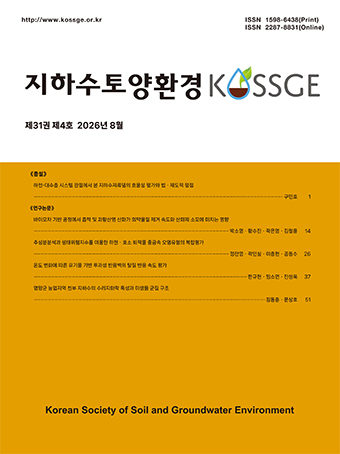 Journal of Soil and Groundwater Environment