

Instructions for Authors
1. Purpose
These instructions provide detailed guidelines for authors regarding the preparation and submission of manuscripts to the Journal of Soil and Groundwater Environment, published by the Korean Society of Soil and Groundwater Environment (KoSSGE).
2. Types of Manuscripts
The journal accepts the following types of manuscripts related to soil and groundwater environments: research articles, review articles, technical notes, field reports, discussions, and editorials. Submission of a manuscript implies that the work has not been published previously and is not under consideration for publication elsewhere.
(1) Research articles present original research findings with scientifically significant results, clear conclusions, and supporting evidence.
(2) Review articles provide a comprehensive analysis of existing literature, highlighting current knowledge, limitations, and future research directions.
(3) Technical notes report original but concise research findings, including preliminary results or novel methodologies of scientific interest.
(4) Field reports describe scientific or technical findings based on field investigations, including design, operation, and maintenance of environmental facilities.
(5) Special features are invited contributions on selected topics, coordinated by the editorial board.
(6) Discussions provide critical comments or questions regarding articles previously published in the journal. Such submissions must be made within two years of the original publication.
(7) Editorials are short opinions written by experts invited by the editorial board.
3. Eligibility for Submission
At least one of the authors must be a member of the Korean Society of Soil and Groundwater Environment (KoSSGE). Exceptions may be made for manuscripts resulting from collaborations with KoSSGE members, as well as for invited contributions such as special features.
4. Research & Publishing Ethics
Authors must comply with the research and publication ethics guidelines provided by KoSSGE. All authors are required to submit a completed Author’s Checklist, confirming adherence to ethical standards, including originality, authorship, and conflict of interest. Plagiarism, data fabrication, falsification, and duplicate submission are strictly prohibited.
5. Copyright Transfer Agreement
Upon acceptance of a manuscript, authors are required to complete and submit a signed Copyright Transfer Agreement to KoSSGE.
6. Review Process
All submitted manuscripts undergo a peer review process conducted by at least two independent reviewers. The editorial committee makes the final decision on acceptance, revision, or rejection based on the reviewers’ comments. Authors may be requested to revise their manuscripts in accordance with the reviewers’ and editors’ recommendations. The editorial committee is responsible for the final decision regarding publication. The journal operates a single-blind peer review process.
7. Manuscript Language and Length
1. Manuscripts may be written in either Korean or English; however, the use of English is encouraged to enhance accessibility for international readers. An English abstract of no more than 200 words is required.
2. Manuscripts should be prepared using Hangul (HWP) or Microsoft Word (DOC or DOCX) and formatted on A4 paper with double spacing and margins of 3 cm on all sides.
3. There are no strict length limitations for manuscripts. However, all manuscripts should be written concisely and clearly.
8. Structure of Manuscript
1. Manuscripts written in Korean or English should be organized in the following order: TITLE page, ABSTRACT (in English), Introduction, Methods (or Materials and Methods), Results, Discussion (or Results and Discussion), Conclusion, Acknowledgement, Nomenclature, References, Tables and Figures.
2. The title page (first page) must include the title, author name(s) and affiliation(s) in both Korean and English. For multiple authors, the corresponding author should be indicated with an asterisk (*), and the corresponding author’s e-mail address should be provided as a footnote on the first page. Author(s) with different affiliation(s) should be identified using superscript numbers.
3. The English abstract should provide a concise summary of the purpose, methods, major findings, and conclusions of the study. For Technical Notes, Technical Reports, and Field Report, an abstract may be omitted if appropriate.
4. Up to five keywords should be listed at the end of the abstract.
Ex) Key words: Dechlorination, Reductive degradation, Carbon tetrachloride, TCE
5 Arabic numerals should be used to indicate heading levels in the main text (from Introduction to Conclusion).
Ex) 1, 2, 3, …, 1.1, 1.2, …, 1.1.1, 1.1.2, …, (1), (2), (3), …
6. The main text should be written using standard academic terminology. Proper noun(s) should be written in their original language.
7. Quantitative values should be expressed using Arabic numerals. SI units should be used, with a space between the numerical value and the unit symbol, except for % (percent) and ℃ (degree Celsius)
Ex) 1.5 mg/L, 1.5 mg/kg, 25%, 13.1
9. Preparation of Tables and Figures
1. All tables and figures must have clear and concise titles in English. Captions should provide sufficient information to allow understanding without referring extensively to the main text.
2. Tables and figures should be numbered consecutively using Arabic numerals and cited in the text in the following format:
Ex) Table 1, Table 2, Fig. 1, Fig. 2
3. Tables and figures should be prepared on separate pages from the main text and submitted in a consistent format.
4. Table titles should be placed above the table. Only the first word should be capitalized, and no period is required at the end.
Ex) Table 1. Physical characteristics of activated carbon
5. Figure captions should be placed below the figure. Only the first word should be capitalized, and a period should be placed at the end.
Ex) Fig. 1. Photograph of the SVE box experiment system.
10. Preparation of Reference
1. References must be written in English and listed alphabetically by the surname of the first author.
2. References should be cited in the text using the author–year system as follows. All authors’ names must be included in the reference list.
① Two authors:
Ex) Wood and Sanford (1995) reported that ...
Ex) ... has been reported (Wood and Sanford, 1995).
② Three or more authors:
Ex) Walker et al. (1991) reported that ...
Ex) ... has been reported (Walker et al., 1991).
③ If multiple references by the same author(s) published in the same year are cited, use a, b, c, etc. after the year:
Ex) Wood and Sanford (2004a), Wood and Sanford (2004b)
3. Research Articles, Review Articles, Technical Notes, Technical Reports, Field Reports, Special Features, Discussions, and Editorials should follow the reference styles below
① Journal articles should include authors’ surnames followed by initials, year of publication, article title, journal title (abbreviated according to CASSI), volume number (issue number), and page range.
Ex) Wood, W.W. and Sanford, W.E., 1995, Chemical isotopic methods for quantifying ground-water recharge in a regional, semiarid environment, Ground Water, 33(3), 458-468.
Ex) Walker, G.R., Jolly, I.D., and Cook, P.G., 1991, A new chloride leaching approach to the estimation of diffuse recharge following a change in land use, J. Hydrol., 128, 49-67.
② Conference proceedings should include authors’ surnames followed by initials, year, title of the paper, conference name, meeting location, and page range.
Ex) Pritchett, J., 1995, Star: A geothermal reservoir simulation system, Proceedings of the World Geothermal Congress, Int. Geotherm. Assoc., Florence, Italy, p.2959-2963.
③ Books with authors should include authors’ surnames followed by initials, year, book title, edition (if applicable), publisher, and place of publication.
Ex) Anderson, M.P. and Woessner, W.W., 1992, Applied Groundwater Modeling: Simulation of Flow and Advective Transport, Academic Press, San Diego, CA.
④ Chapters in edited books should include authors’ surnames followed by initials, year, chapter title, editor(s), book title, publisher, place of publication, and page range.
Ex) Allison, G.B., 1988, A review of some of the physical, chemical and isotopic techniques available for estimating groundwater recharge, In: I. Simmers(ed.), Estimation of Natural Groundwater Recharge, Reidel Publishing Company, The Netherlands, p.49-72.
⑤ Journal title abbreviations should follow the Chemical Abstracts Service Source Index (CASSI).
⑥ Web references should include the full URL and the date of access. Additional information such as DOI, author names, publication dates, and source information should be provided whenever available.
Ex) Annual Review of Global Pulp and Paper Statistics, http://www.risiinfo.com/product/annual-review-of-global-pulp-paper-statistics [accessed March 17, 2022]
11. Manuscript Submission and Acceptance
1. Manuscripts must be submitted through the journal’s online submission system available on the Society’s homepage (submission.jsge.or.kr).
2. The date of submission is defined as the date on which the manuscript is received by the editorial office. The date of acceptance is defined as the date on which the final decision for publication is made by the editorial committee.
3. All submitted manuscripts are subject to an initial editorial screening to assess their suitability for the journal. Manuscripts that fall outside the scope of the journal or do not meet basic quality standards may be rejected without external review.
4. All manuscripts that pass the initial screening undergo a peer review process in accordance with the journal’s review policy.
5. The editorial committee makes the final decision on acceptance, revision, or rejection based on the reviewers’ comments and editorial judgment.
6. Authors may be requested to revise their manuscripts in accordance with the reviewers’ and editors’ recommendations.
7. The editorial committee strives to ensure a fair, timely, and unbiased review process.
8. Authors must complete and submit the Author’s Checklist provided by the Society at the time of submission.
12. Editing
1. The first proofreading is to be done by the author, where correction, inclusion or edition of any content are not to be allowed unless caused by printing errors.
2. The Editorial Board has the authority to revise the paper, only without making any changes to its contents.
(1) The corresponding author is responsible for proofreading the manuscript. Only minor corrections, such as typographical or formatting errors, are allowed at this stage.
(2) The Editorial Board reserves the right to make editorial revisions for clarity, consistency, and formatting, without altering the scientific content of the manuscript.
13. Review and Publication Fees
1. The following requirements must be fulfilled prior to manuscript review and consideration for publication.
(1) A review fee of KRW 60,000 per manuscript must be paid at the time of submission.
(2) At least one of the authors, preferably the corresponding author, should be a member of the Korean Society of Soil and Groundwater Environment (KoSSGE). Membership fees for the applicable year must be paid accordingly.
2. If the manuscript is accepted for publication, the following publication charges apply:
(1) A publication fee of KRW 120,000 is charged for up to 10 printed pages. An additional KRW 20,000 will be charged for each extra page.
(2) Additional charges may apply under the following circumstances:
- Color printing is required.
- More than 20 offprints are requested, or printed covers for offprints are requested.
14. Publication Schedule and Editorial Authority
1. The journal is published bimonthly, with six regular issues per year, in February, April, June, August, October, and December. Each issue is published on the last day of the respective month.
2. Special issues may be published additionally when necessary, subject to the decision of the Editorial Board.
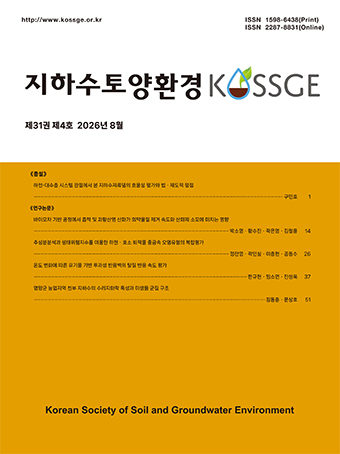 Journal of Soil and Groundwater Environment